
HRV & Ventilation for Edmonton Homes
Fresh air without losing conditioned heat — heat recovery ventilation is often required for new builds and increasingly common in retrofits.
What Ventilation Services Cover
The main considerations for Edmonton residential and commercial properties.
HRV Installation
Heat Recovery Ventilators exchange stale indoor air with filtered outdoor air while recovering 75–85% of the heat from the exhaust stream. Code-required for most new Edmonton builds, strongly recommended for tight retrofits.
ERV Installation
Energy Recovery Ventilators do everything an HRV does plus manage moisture — transferring humidity between exhaust and supply air. Better suited for very tight Edmonton new-builds where winter dryness is a problem.
HRV/ERV Repair
Service and repair for existing ventilation equipment — motor failures, frozen cores, unbalanced airflow, control board issues, and clogged filter troubleshooting.
HRV/ERV Maintenance
Annual cleaning of the heat exchange core, filter service, condensate line clearing, and airflow verification. Neglected HRVs lose efficiency fast and can develop frost/moisture issues in Edmonton winters.
Kitchen & Bath Exhaust
Range hood venting, bathroom exhaust fan install and repair, dryer venting — the small ventilation systems that keep moisture, odours, and combustion by-products out of the living space.
Air Balancing
Diagnosis and correction of pressure imbalances that cause cold rooms, backdrafting fireplaces, or persistent draft complaints. Involves measuring airflow at each register and adjusting dampers or system balance.
Ductwork Assessment
Inspection of duct condition, leakage testing, sizing verification, and reworking for additions, renovations, or unbalanced systems. Duct problems drive many comfort complaints homeowners blame on the furnace or AC.
Common Ventilation Services Problems in Edmonton
The specific issues Edmonton homeowners run into — and what typically causes them.
Condensation on windows
Water beading on window glass or frames in winter. Indicates indoor humidity is higher than the windows can handle — usually resolved by adding controlled ventilation (HRV/ERV) rather than by turning off a humidifier.
Musty basement smell
Damp, mildew smell from basement or crawl space. Combination of humidity buildup and poor air movement. Often needs both source correction (moisture control) and better air exchange.
Stuffy feeling at home
Air feels stale, heavy, or 'used' even in a clean house. Sign of elevated CO2 from occupants + no fresh air exchange. HRV/ERV brings the numbers back to a normal range.
Cooking smells linger for hours
Range hood runs but smells stay in the house. Usually an inadequate exhaust fan (too weak, wrong CFM), improperly ducted (recirculating instead of venting outside), or a house too tight to allow makeup air.
Bathroom fan takes forever to clear steam
Long-running shower and the mirror stays fogged 20+ minutes later. Undersized fan, blocked or leaky ductwork, or a fan venting into the attic instead of outdoors — code violation, but common in older homes.
HRV frost buildup or leaking
Ice on the HRV core or water pooling under the unit. Usually a defrost cycle problem, a blocked condensate line, or an unbalanced system pulling in more cold air than it exhausts warm air.
Whistling or noisy vents
High-pitched noise from vents or return grilles. Almost always undersized ductwork or partially closed dampers restricting airflow. Diagnostic requires measuring static pressure and airflow at multiple points.
One room always cold or hot
Same house, one room 5°C different from the rest. Duct-balance issue: undersized supply, no return path, closed dampers, or long duct runs losing heat. Fixable with airflow balancing rather than replacing equipment.
Ventilation in Edmonton's Tight Homes
Alberta's National Building Code requirements for new construction now mandate mechanical ventilation — HRV or ERV systems — in airtight homes. This reflects a practical reality: homes built to current energy efficiency standards don't have enough uncontrolled air infiltration to maintain healthy indoor air quality on their own.
For existing Edmonton homes, the case for adding mechanical ventilation is often just as clear: persistent moisture on windows, musty basement odours, and stuffy rooms in winter are all signs of a home that needs controlled air exchange rather than hoping for drafts.
HRV systems recover 75-85% of the heat from exhaust air in Edmonton's climate, meaning you're getting fresh air without paying to heat it from scratch. In a heating season that runs from October to April, that efficiency recovery is meaningful on the annual utility bill.
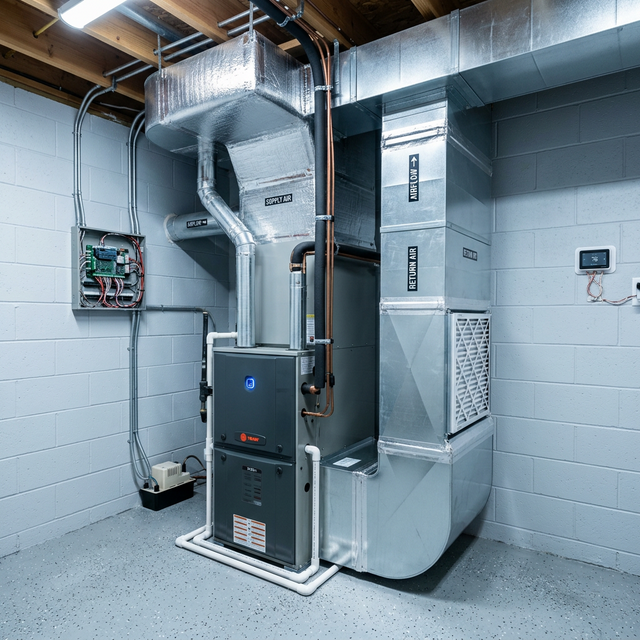
Edmonton Ventilation Services: Cost & Rebates
Edmonton ventilation upgrades range from simple bath fan replacements to full HRV/ERV installs. Cost depends on whether ductwork already exists and the size of the system needed.
Typical Cost Ranges
Rebates & Incentives
- Canada Greener Homes GrantHRV and ERV systems can qualify as part of a broader efficiency upgrade — requires pre and post energy audit.
- Canada Greener Homes LoanInterest-free financing up to $40,000 for eligible ventilation, insulation, and efficiency upgrades.
- Utility & Manufacturer RebatesSeasonal promotions from HRV/ERV manufacturers (Venmar, Broan, Panasonic, Aprilaire) often available through installers.
- New Home Warranty ComplianceNot a rebate — but proper HRV commissioning is often required to maintain new home warranty coverage and code compliance for airtight builds.
Dedicated pages for the most-searched Edmonton HVAC needs — same connection service, faster access to what's most relevant to your situation.
Frequently Asked Questions
What is an HRV and do I need one in Edmonton?
An HRV (Heat Recovery Ventilator) exchanges stale indoor air with fresh outdoor air while recovering up to 80% of the heat from the exhaust air. In Edmonton's airtight, well-insulated homes, HRVs are often required for new construction and strongly recommended for retrofits to maintain indoor air quality without wasting heat energy.
HRV vs ERV — which is right for Edmonton?
HRVs transfer heat only; ERVs transfer both heat and humidity. In Edmonton's very dry winters, an ERV helps retain some indoor moisture when it would otherwise be exhausted — meaningful for tight new-builds where winter humidity struggles to stay above 20%. HRVs are the practical choice for older homes with normal air leakage. Newer, tighter homes benefit from ERVs.
How often should HRV filters be cleaned?
HRV filters should be cleaned every 3 months and the heat exchanger core inspected annually. In Edmonton, cleaning before heating season in fall and again in spring after pollen season peaks is the practical schedule. Neglected HRV filters reduce system efficiency and can cause frost buildup in the core during cold weather.
Can poor ventilation cause health problems?
Yes. In tightly sealed Edmonton homes, VOCs from building materials, CO2 from occupants, and moisture from cooking and bathing can accumulate without proper ventilation. Symptoms include headaches, fatigue, and respiratory irritation. An HRV system resolves this while maintaining energy efficiency — typically required under the National Building Code for airtight new builds.
What causes HRV frost buildup?
Extreme cold combined with high indoor humidity. When -25°C exhaust air hits the core, moisture condenses and can freeze. Modern HRVs have automatic defrost cycles that recirculate warm air periodically. If frost buildup is a repeat problem, the defrost cycle timing may need adjustment, indoor humidity may be too high, or the unit may be undersized for the home.
How long does an HRV last?
Well-maintained HRVs typically last 15–20 years in Edmonton. Motors and control boards are the most common wear items. Regular filter service and annual core cleaning meaningfully extend lifespan and preserve heat recovery efficiency.
Do I need code permits for HRV installation?
Yes. Alberta and Edmonton require permits for mechanical ventilation installations. HRV commissioning (airflow balancing and documentation) is often required for new build occupancy permits and may affect new home warranty compliance. Reputable installers handle permits and commissioning as part of the job.
Can I add an HRV to an existing home?
Yes, and it's increasingly common in Edmonton retrofits. Adding an HRV requires ductwork routing (either integrated with existing HVAC ducts or dedicated ventilation ducts), an outdoor termination, and electrical hookup. Cost is typically higher than in new construction because of the retrofit routing work, but often the fix for persistent condensation, air quality, or stuffy-air complaints in tight homes.
Ventilation Services Across the Edmonton Capital Region
Select your community to see local service details and what sets your area apart.
Edmonton & Major Suburbs
Don't see your area? Call us — we may still serve you.
Call (825) 402-7112