
Heat Pump Installation in Edmonton
Cold-climate heat pumps designed for Alberta winters — usually paired with a gas furnace as backup for the coldest weeks. Federal Greener Homes rebates plus provincial and municipal programs make this the most-subsidized major HVAC upgrade available in Edmonton right now.
What Heat Pump Installation Cover
The main considerations for Edmonton residential and commercial properties.
Cold-Climate Heat Pump Installation
Cold-climate rated heat pumps (Mitsubishi Hyper-Heat, Daikin Fit, Bosch IDS, Carrier Infinity) heat effectively down to -25°C or lower. Sizing and cold-climate certification both matter — a standard heat pump loses too much capacity below -15°C to work in Edmonton.
Dual-Fuel Setup (Heat Pump + Gas Furnace)
The most practical Edmonton configuration: heat pump runs efficiently October–April in the milder ranges; gas furnace takes over during -25°C+ cold snaps. Best of both — heat pump efficiency plus furnace reliability for extremes.
Rebate Documentation & Applications
Canada Greener Homes Grant, Greener Homes Loan, provincial programs, and City of Edmonton loan program each have their own application, energy audit, and paperwork requirements. Rebate stacking can cover $5,000–$15,000+ of installation cost when done properly.
Retrofit vs New-Build Installation
Retrofits: duct compatibility, existing furnace integration, electrical panel capacity, and refrigerant line routing all matter. New builds: designed-in from the start with proper zoning and ductwork. Different projects, different considerations.
Common Heat Pump Installation Problems in Edmonton
The specific issues Edmonton homeowners run into — and what typically causes them.
Non-cold-climate heat pump underperforming
Standard heat pumps installed in Edmonton by out-of-market contractors underperform badly below -15°C. If a system was sold without cold-climate certification, that's usually why.
Balance point set wrong
Dual-fuel systems switch from heat pump to gas at a 'balance point' temperature. Set too high = you burn gas unnecessarily. Set too low = the heat pump runs at poor efficiency. Correct setup is a commissioning step often skipped.
Electrical panel capacity
Cold-climate heat pumps need meaningful electrical capacity — often a dedicated 30–60A 240V circuit. Older Edmonton homes with 100A service sometimes need a panel upgrade as part of the install, which affects the cost calculation.
Defrost cycles in extreme cold
Heat pumps run defrost cycles when outdoor coils frost up. Frequency spikes below -15°C — normal but sometimes mistaken for a malfunction. Proper commissioning explains what's normal for your unit.
Missed rebate opportunities
Federal Greener Homes rebates require a pre-install EnerGuide audit. Skip the audit, forfeit up to $5,000 in rebates. Timing and paperwork sequencing matters — worth confirming before install.
Improper refrigerant line runs
Long line runs, tight bends, and inadequate insulation all degrade heat pump performance permanently. Line-set quality is one of those install details that separates good work from bad — hard to see, easy to skip.
Heat Pumps in Edmonton — What Actually Works
Cold-climate certification is the single most important spec for a heat pump destined for Edmonton. Standard heat pumps lose too much capacity below -15°C to work here. Cold-climate rated units (Mitsubishi Hyper-Heat, Daikin Fit, Bosch IDS, Carrier Infinity Cold-Climate) heat effectively down to -25°C and continue producing meaningful heat below that.
The most practical Edmonton configuration is dual-fuel: heat pump handles roughly 80–90% of the heating season efficiently, gas furnace takes over during the coldest weeks. This captures the efficiency of a heat pump for the milder ranges of the seven-month heating season, plus the reliability of gas for extreme cold snaps that push heat pump efficiency down.
Rebate stacking is what makes the math work for most Edmonton homes. Canada Greener Homes Grant (up to $5,000) plus interest-free Greener Homes Loan (up to $40,000) plus City of Edmonton Change Homes for Climate loan plus manufacturer and utility rebates can commonly cover $5,000–$15,000 of installation cost — often bringing net out-of-pocket in line with a high-efficiency furnace replacement.
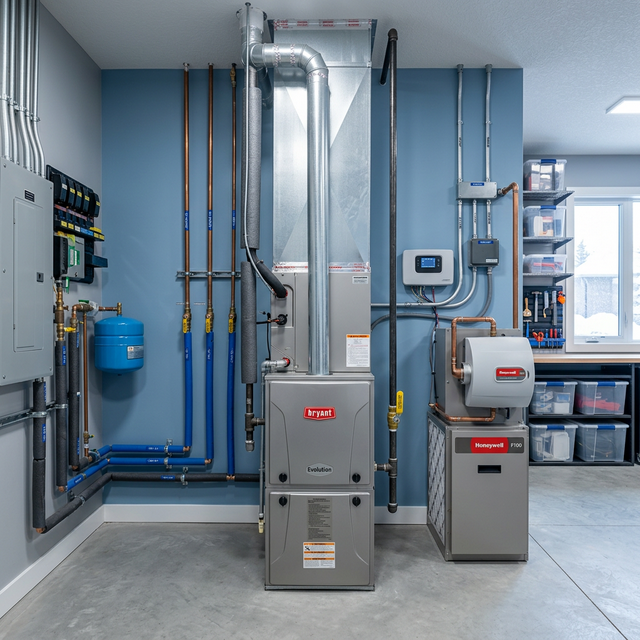
Edmonton Heat Pump Installation: Cost & Rebates
Heat pump installation is the largest single HVAC investment for most Edmonton homes, but also the most-rebated. Actual out-of-pocket after rebates often falls in the $5,000–$10,000 range for a mid-sized home — comparable to a high-efficiency furnace replacement.
Typical Cost Ranges
Rebates & Incentives
- Canada Greener Homes GrantUp to $5,000 for heat pump upgrades. Requires pre-install and post-install EnerGuide audits. Applications processed by Natural Resources Canada.
- Canada Greener Homes LoanInterest-free loan up to $40,000, 10-year term, for eligible retrofits including heat pumps. Combines with the Grant.
- Oil to Heat Pump Affordability ProgramFor homes currently heated with oil, up to $10,000–$15,000 in additional federal funding on top of the standard Grant. Relevant to a small number of Edmonton homes still on oil.
- City of Edmonton — Change Homes for Climate loanMunicipal low-interest loan program for home energy upgrades. Loan is attached to the property (LIC) rather than the homeowner. Check current status before applying.
- Alberta provincial programsProgram landscape shifts year to year — worth confirming current active programs at time of quote.
- Manufacturer & utility rebatesSeasonal promotions from Mitsubishi, Daikin, Carrier, Lennox, and Alberta utility providers often stack with federal programs.
Dedicated pages for the most-searched Edmonton HVAC needs — same connection service, faster access to what's most relevant to your situation.
Frequently Asked Questions
Do heat pumps actually work in Edmonton's -40°C winters?
Cold-climate heat pumps work well down to about -25°C, and continue producing heat (at reduced capacity) below that. But no heat pump is efficient at -40°C. The practical answer for Edmonton is a 'dual-fuel' setup: heat pump runs efficiently October–April in the mild-to-moderate cold ranges, and a gas furnace takes over as backup during the coldest weeks. This captures roughly 80–90% of the heating season on heat pump efficiency while keeping the reliability of gas for extreme cold.
What rebates are actually available for Edmonton heat pumps in 2026?
The federal Canada Greener Homes Grant (up to $5,000) plus Greener Homes Loan (up to $40,000 interest-free) are the largest, and open to Alberta homeowners. City of Edmonton offers the Change Homes for Climate loan program. Provincial programs shift year to year and are worth confirming at time of quote. Manufacturer and utility rebates on specific brands (Mitsubishi, Daikin, Carrier, Lennox) often stack on top. Total rebate + loan stacking commonly covers $5,000–$15,000 of installation cost.
Heat pump vs high-efficiency furnace — which is better for Edmonton?
For most Edmonton homes, the practical answer is 'both, in a dual-fuel setup.' A heat pump alone struggles with -30°C stretches. A furnace alone misses the efficiency and cooling benefits of a heat pump for the ~80% of the heating season above -15°C. Dual-fuel captures the strengths of both: heat pump efficiency for the shoulder seasons and moderate winter days; furnace reliability and cheap gas heat for the coldest weeks. It also gives you AC in summer as a bonus — the heat pump reverses to cool.
Will a heat pump lower my Edmonton utility bills?
For gas-heated homes: usually yes, over a full year — the heat pump replaces most gas consumption with electricity at 2–3x higher efficiency than gas, and Alberta's high gas rates make that math work harder than in provinces with cheap gas. For homes with expensive electricity: the math is closer to break-even. Total bill impact depends on the specific home, current furnace efficiency, insulation levels, and whether you're going full heat pump vs dual-fuel. A proper energy audit can model this before you commit.
How long does heat pump installation take?
Ducted retrofit installation: 2–3 days for straightforward jobs, 4–5 days if electrical panel upgrade or ductwork modifications are needed. Ductless mini-split: 1–2 days for single-zone, 3–5 days for multi-zone. New-build: designed in from the start, typically no longer than a standard furnace-and-AC install. Rebate paperwork (EnerGuide pre and post audits) adds 4–8 weeks to the overall timeline before rebate cheques arrive.
What's the lifespan of a heat pump in Edmonton?
Cold-climate heat pumps typically last 15–20 years in Edmonton with proper installation and annual maintenance. Coil corrosion from prairie salt and dust is a factor in outdoor unit lifespan; annual coil rinsing helps meaningfully. The heat pump industry has matured significantly in the last 5 years — units installed today are more reliable in cold climates than models from even 2020.
Do I need to upgrade my electrical panel for a heat pump?
Depends on the home. A cold-climate heat pump typically needs a dedicated 30–60A 240V circuit. Newer Edmonton homes with 200A service usually have capacity. Older homes with 100A service sometimes need a panel upgrade ($1,500–$4,000) as part of the install. Load calculation should be part of any heat pump quote — not an unexpected add-on you find out about mid-install.
Can I use my existing ductwork with a heat pump?
Usually yes, if the ductwork was properly sized for the original furnace. Heat pumps move more air at lower temperatures than furnaces, so some duct systems that worked fine for a furnace end up undersized for a heat pump — resulting in noise, poor room-to-room balance, or reduced heat pump efficiency. Duct assessment should be part of the pre-install evaluation.
Heat Pump Installation Across the Edmonton Capital Region
Select your community to see local service details and what sets your area apart.
Edmonton & Major Suburbs
Don't see your area? Call us — we may still serve you.
Call (825) 402-7112